July 23, 2026
Wondering whether Forest Hills or Brentwood offers more privacy? If you are weighing both areas, you are probably trying to balance seclusion, everyday convenience, and the feel of the homes around you. The good news is that both communities can offer a private setting, but they do it in different ways. Here is what to know so you can compare them with more confidence. Let’s dive in.
If privacy is your top priority, Forest Hills generally has the stronger citywide advantage. The city describes itself as almost entirely residential, with no commercial development and no high-density housing. Its population density is also much lower, at about 542 people per square mile across 9.3 square miles.
Brentwood has a different setup. The city describes itself as a premier residential and office community with retail and restaurant areas, and its land use is about 90% residential, 5% commercial, and 5% service institutional. With 45,373 residents across 41.11 square miles, Brentwood works out to roughly 1,104 people per square mile, or about twice the density of Forest Hills.
That does not mean Brentwood lacks privacy. It means privacy in Brentwood is often more dependent on the specific neighborhood, subdivision pattern, and lot placement. In Forest Hills, the overall city framework is more consistently geared toward separation and low visual activity.
Forest Hills zoning leans heavily into an estate-style character. Its residential districts range from 6-acre E1A lots down to 1-acre NC1 and NC2 lots, and the zoning code says these districts are intended to preserve countryside, park-like, and estate character.
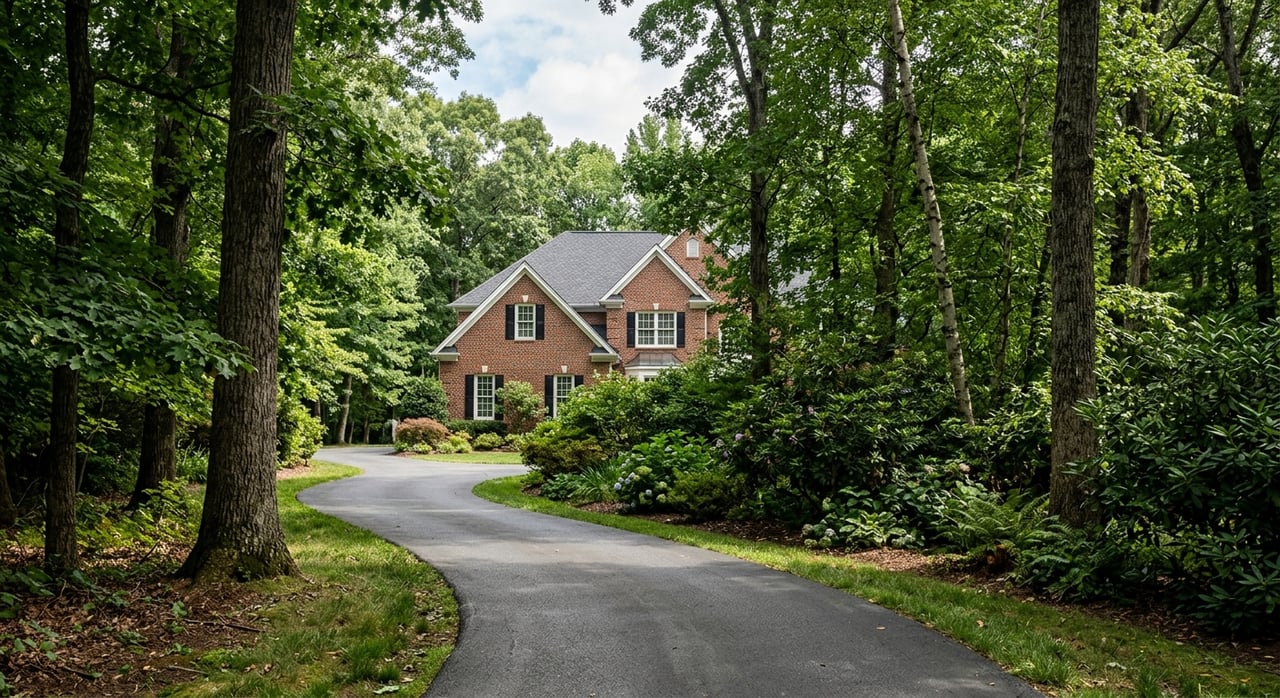
That framework matters because bigger lots and deeper setbacks usually create more physical distance between homes. Forest Hills zoning also includes front-yard setbacks as high as 150 feet and rear setbacks as high as 100 feet. In practical terms, that often means longer driveways, deeper front yards, and fewer direct sightlines from the street.
For a buyer who values quiet spacing and less visibility, this is a meaningful advantage. The privacy is not just a feature of one subdivision. It is built into much of the city’s development pattern.
Brentwood also offers large-lot living, but the pattern is more mixed. According to the city’s planning guide, AR lots are 3 acres, R-1 lots are 2 acres, and R-2 lots are 1 acre.
Brentwood also allows some open-space residential developments where lots can be smaller than one acre if preserved open space keeps the overall project at a one-acre density. That means one Brentwood neighborhood may feel very spacious, while another may feel more planned around shared open space and internal buffering.
The result is flexibility. If you want privacy plus access to more nearby services, Brentwood can be a strong fit. You just need to evaluate privacy at the property and subdivision level rather than assuming the same feel across the entire city.
When you compare privacy, lot size is only part of the picture. Setbacks, buffers, and where a home sits on its parcel can shape how private it feels day to day.
Forest Hills stands out here because its code supports very deep setbacks in several districts. Those standards can reduce direct street exposure and increase distance from neighboring structures.
Brentwood uses privacy tools too, especially in more sensitive planning areas. The city applies a 100-foot setback plus a 50-foot landscaped buffer in the AR-IP district along Old Smyrna Road, and its hillside overlay requires a 3-acre minimum lot area in those areas.
This is why Brentwood privacy often feels location-specific. A home in an estate or hillside setting may offer substantial seclusion, while another home in a different development pattern may feel more connected to nearby streets and activity.
Privacy is not only about what is on paper in the zoning code. It is also about what you see, hear, and experience from the house itself.
Forest Hills places a strong emphasis on hillside and tree protection. The city says much of the land lies on hillsides and steep slopes, and its overlay rules are designed to preserve trees, limit erosion, and protect topography. Its preservation approach also highlights scenic vistas, environmental features, and unique landscapes.
That natural setting can make a major difference in everyday privacy. Mature tree cover, rolling terrain, and preserved landscape features can soften sightlines and reduce the sense of being close to surrounding homes.
Forest Hills also borders Radnor Lake and Warner Parks on its east and west boundaries. That helps reinforce a wooded, lower-visual-noise environment that many buyers associate with retreat-like living.
Brentwood also benefits from natural screening. The city describes itself as known for pristine hills, lush forests, and parks and greenways. In hillside overlay areas, reduced density can help preserve a more secluded setting.
Still, the experience varies more from one Brentwood neighborhood to the next. Some areas feel tucked away and heavily screened, while others feel more connected to broader residential and commercial activity.
For many buyers, the real question is not simply which city is more private. It is how much convenience you want to trade for that privacy.
Forest Hills is usually the quieter option because it has no commercial development. That can support a more peaceful and low-activity environment, but it also means your daily errands often depend on nearby Nashville corridors rather than destinations inside the city.
Brentwood is more self-contained. The city actively points to its retail and restaurant scene, and planning materials reference commercial nodes such as Maryland Farms, CityPark Brentwood, Hill Center Brentwood, Cool Springs Festival, and General George Patton Drive.
If you want stronger separation from commercial activity, Forest Hills may feel more aligned with your goals. If you want privacy along with easier access to shopping, dining, and services, Brentwood may be the more practical compromise.
On a citywide basis, Forest Hills usually has the edge. Its lower density, estate-style zoning, deeper setbacks, tree and hillside protections, and lack of commercial development all point in the same direction.
Brentwood can absolutely offer privacy too, especially in estate, hillside, and open-space subdivision patterns. But the level of seclusion is more likely to depend on the exact parcel, overlay status, and neighborhood layout.
If your goal is maximum privacy first, Forest Hills is generally the stronger choice. If your goal is privacy with more built-in convenience, Brentwood often offers the better balance.
If you are touring homes in either area, it helps to look beyond the listing photos. Privacy is highly parcel-specific, even in communities known for larger lots.
Here are a few practical things to review:
A calm, data-driven review can help you avoid assumptions. Two homes with similar square footage can offer a very different day-to-day experience once you account for lot placement, screening, and surrounding land use.
If you are comparing Forest Hills and Brentwood, this is where local guidance becomes especially valuable. A neighborhood may look private online but feel very different in person depending on topography, road exposure, and how the homes are positioned.
Choosing between these two areas often comes down to the kind of privacy you want. Some buyers want a true retreat feel with minimal commercial activity nearby. Others want strong screening and larger lots without giving up easy access to daily services. The right answer is usually the one that matches how you actually live.
When you want a thoughtful, property-by-property view of Brentwood-area tradeoffs, Donna Stumpf can help you compare your options with clarity.
Stay up to date on the latest real estate trends.
July 23, 2026
July 16, 2026
July 9, 2026
July 2, 2026
June 25, 2026
June 18, 2026
June 11, 2026
June 4, 2026
May 28, 2026
Buying or selling a home is more than a transaction—it’s a life moment. I’ll be your trusted partner, guiding you with expertise, honesty, and a smile every step of the way.
Donna Stumpf
8119 Isabella Ln Ste 105 Brentwood TN 37027